Understanding the new Gloucestershire 11+ and how to prepare your child
The Compass Paper is one of three papers in the new Gloucestershire FSCE 11+, which children will first sit in July 2027 for entry to grammar school in September 2028.
Compass assesses children’s knowledge and understanding across a broad range of primary school subjects through multiple-choice questions.
The official subject list includes:
- Science
- History
- Geography
- Art & Design
- Computing
- Design & Technology
- Languages
- Music
- Physical Education
- English
- Maths
Questions draw on knowledge and skills taught up to the end of Year 5.
Importantly, Compass is not simply about memorising facts. Children need to understand what they have learnt, recognise relevant vocabulary and apply their knowledge to unfamiliar situations.
Much of the underlying knowledge will already have been taught at school. The challenge is learning to use it confidently and independently.
What Does the FSCE Compass Paper Assess?
The FSCE places an emphasis on applying existing knowledge, thinking critically and solving problems.
The official familiarisation material provides examples of how children may be expected to use their understanding rather than simply recall information.
Science: Applying Knowledge to Investigations
Children need a sound understanding of scientific concepts and the skills involved in planning and interpreting investigations.
For example, a Science question in the official familiarisation guide involves investigating how the distance from a light source affects shadows.
This provides a useful opportunity to consider the principles of a fair test.
Children need to understand that the distance is the variable being changed, while other relevant conditions, such as the object and light source, should remain the same. They also need to think about suitable equipment and how results could be recorded.
Understanding what makes a test fair is the starting point. Applying that understanding to a particular investigation requires an additional level of thinking.
Geography and History: Interpreting Evidence
In Geography, children benefit from being able to interpret maps, understand geographical features and use information about different environments.
History involves using knowledge of the past and examining evidence carefully.
An object discovered at a Roman settlement, for example, might provide clues about how people lived. Children need to distinguish between what the evidence supports and what would simply be an assumption.
These are illustrations of the reasoning skills developed through the primary curriculum, rather than predictions of specific Compass questions.
Knowledge Across the Wider Curriculum
The other foundation subjects also develop knowledge and skills that children may need to apply.
Computing includes logical thinking, instructions and algorithms. Art & Design and Design & Technology involve understanding materials, techniques and design choices.
Music includes concepts such as rhythm, pitch and tempo. Languages develop vocabulary recognition and an understanding of language patterns, while Physical Education includes movement, balance and coordination.
English and Maths are also included in the official Compass subject list, although they feature in the Adventure and Beacon papers too.
The precise content of future Compass questions is not known. The most useful preparation is therefore to build secure understanding across the curriculum rather than attempt to predict individual topics.
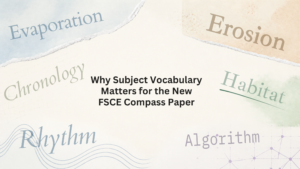
Why Is Subject Vocabulary Important for the FSCE Compass Paper?
A good understanding of subject-specific vocabulary helps children recognise what a question is asking.
For example, a child might know that metal allows heat to pass through it easily but not recognise the scientific term conductor.
Understanding the correct terminology helps children connect what they have learnt at school with unfamiliar examples.
I strongly recommend encouraging children to read widely, including both fiction and non-fiction. Books covering Science, History, Geography and other curriculum subjects are particularly useful for developing vocabulary and general knowledge.
Discussing unfamiliar words and encouraging children to explain their meanings can help strengthen understanding.
Developing Independent Thinking Skills for the FSCE 11+
One of the most useful skills children can develop is the ability to work through a question when the answer is not immediately obvious.
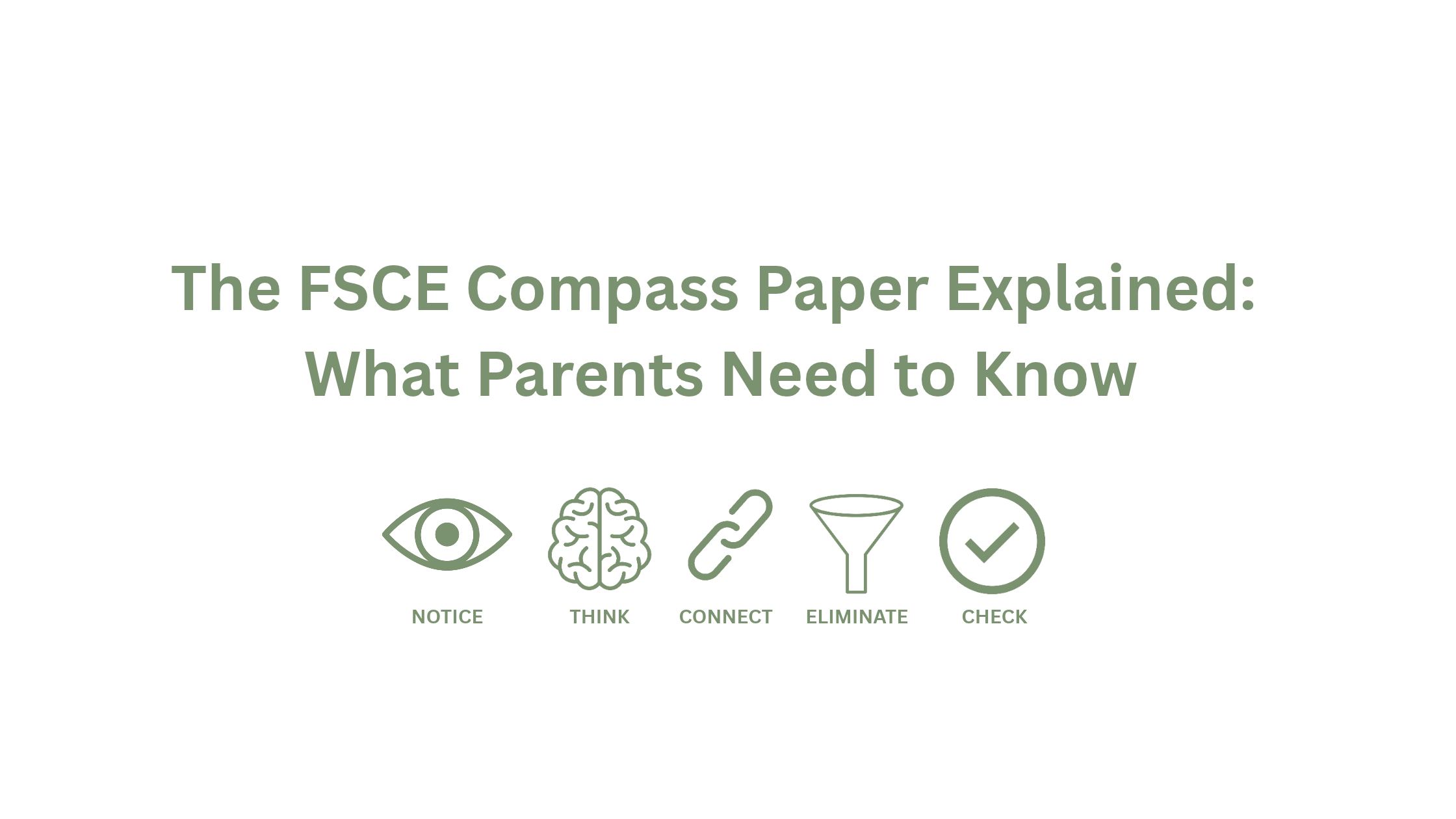
At 11 Plus Practice, I encourage a simple five-step approach:

- NOTICE: Look carefully at the information provided.
- THINK: Identify exactly what the question is asking.
- CONNECT: Draw on relevant knowledge and understanding.
- ELIMINATE: Rule out answers that do not fit the evidence.
- CHECK: Make sure the chosen answer makes sense.
This encourages children to read carefully, identify relevant clues and make reasoned decisions rather than rush into an answer.
The aim is to develop thinking skills that can be applied across different subjects.
How to Help Your Child Prepare for the FSCE Compass Paper at Home
Parents do not need to teach the entire primary curriculum again. A good starting point is taking an interest in what your child is already learning at school.
Encourage your child to explain a science investigation, describe a historical event or demonstrate how to interpret a map.
Everyday activities also provide opportunities to reinforce understanding. Cooking, gardening, visiting museums and exploring the local environment can help children connect classroom learning with real experiences.
Encourage your child to explain their reasoning rather than simply give an answer.
When mistakes occur, discuss them together. A misunderstood word, an overlooked detail or an unsupported assumption can often explain an incorrect response.
Short, regular conversations can help strengthen understanding without making preparation overwhelming.
FSCE Compass Preparation: Learn First, Practise Next
A secure understanding of the underlying subject knowledge and vocabulary provides a strong foundation for Compass preparation.
Children should begin by developing their knowledge, then practise applying it to different examples.
As confidence grows, independent questions can help children learn to identify relevant information, make connections and select answers without additional guidance.
Timed practice can then help children become more familiar with working independently and managing their time.
It is also worth exploring the free official FSCE familiarisation materials, which introduce the question formats and answer sheets children will encounter.
Start Your Child’s 11+ Preparation with Our FREE FSCE Starter Kit
Building a strong vocabulary, improving spelling and reading widely can all help develop the English skills children need for the Gloucestershire FSCE 11+.
Our FREE FSCE Vocabulary & Reading Starter Kit gives you simple activities you can start using at home straight away, including:
- 29 weeks of vocabulary practice
- Tricky spellings
- Synonym activities
- A recommended reading list
It’s a practical way to start building your child’s confidence and developing important English skills alongside their wider Compass preparation.
Download Your FREE FSCE Vocabulary & Reading Starter Kit
Preparing for the Gloucestershire FSCE 11+ with Realistic Mock Tests
Knowing the theory is one thing. Applying it independently under timed examination conditions is another.
At 11 Plus Practice, our Gloucestershire FSCE mock tests are designed to provide realistic preparation across the three papers: Adventure, Beacon and Compass.
Mock tests give children the opportunity to:
- Develop confidence working independently.
- Practise listening to instructions.
- Become familiar with examination conditions.
- Gain experience managing their time.
After each mock test, parents receive:
- Their child’s examination papers, so they can revisit the questions together.
- Their marked answer sheet, showing correct and incorrect answers.
- A cohort ranking and analysis report to help identify strengths and areas for further practice.
These provide valuable feedback on performance and help you understand where your child may benefit from additional preparation.
2027 Gloucestershire FSCE Mock Test Dates
6 February | 6 March | 17 April | 8 May | 12 June
Give your child the opportunity to experience the new FSCE examination format before the real test.
Find Out More and Book Your 2027 Gloucestershire FSCE Mock Test