Understanding the English and Maths questions in the new Gloucestershire 11+ exam and how to help your child prepare.
If your child is preparing for the Gloucestershire 11+ in 2027, you may be wondering what the new FSCE Beacon Paper involves and how best to support them.
The Beacon Paper is one of three papers in the Gloucestershire FSCE 11+, alongside Adventure and Compass.
Like Adventure, Beacon assesses English and Maths using knowledge and skills taught up to the end of Year 5.
However, there is one important difference.
Instead of selecting an answer from multiple-choice options, children must work out and record their own answers.
This may involve completing missing letters, words or numbers. The good news is that lengthy written answers are not required.
Let’s look at what children need to know and how parents can help them prepare.
English: Spelling, Vocabulary and Verbal Skills
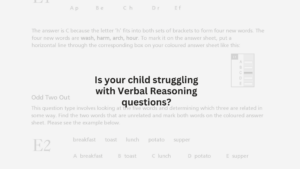
A strong understanding of spelling and vocabulary is particularly important for the FSCE Beacon Paper.
Children need to recognise words, understand their meanings and apply their knowledge to work out answers independently.
Useful areas to practise include:
- Spelling patterns: Recognising common letter combinations and spelling rules.
- Prefixes and suffixes: Understanding how adding letters to the beginning or end of a word changes its meaning.
- Synonyms: Words with similar meanings, such as happy and joyful.
- Antonyms: Words with opposite meanings, such as ancient and modern.
- Homonyms: Words with different meanings, such as seal, which can refer to an animal or a way of closing something.
- Homophones: Words that sound alike but have different spellings or meanings, such as fought and fort.
A child may recognise a word when reading but find it more difficult to spell correctly when letters are missing.
This is why developing spelling accuracy alongside vocabulary knowledge is so valuable.
How can you help at home?
One of the simplest ways to build vocabulary is through regular reading.
Encourage your child to read a mixture of fiction and non-fiction, introducing them to different writing styles and unfamiliar words.
When you come across a new word, talk about:
- What the word means.
- Whether there are other words with similar meanings.
- How the word is spelt.
- Whether it contains a familiar prefix, suffix or spelling pattern.
These small conversations can make a real difference over time.
Give your child a head start with our free vocabulary resource
Building a strong vocabulary is useful across the Gloucestershire FSCE 11+, not just the Beacon Paper.
Our FREE 11+ Vocabulary & Reading Starter Pack is designed to help children develop their vocabulary and reading skills as part of their preparation.
DOWNLOAD YOUR FREE VOCABULARY & READING STARTER PACK
Maths: Applying What Children Know
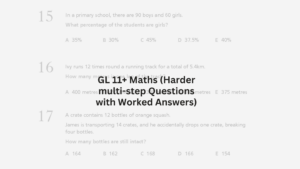
The Maths element of the Beacon Paper draws on knowledge and skills taught up to the end of Year 5.
Important areas include:
- Number and place value
- Addition, subtraction, multiplication and division
- Fractions, decimals and percentages
- Measurement
- Geometry
- Mathematical reasoning and problem-solving
Children may feel confident completing a calculation they recognise but find it more challenging when that same skill appears in an unfamiliar problem.
The key is not simply knowing how to calculate an answer, but understanding when and how to use different mathematical skills.
How can you help at home?
Encourage your child to explain how they reached an answer.
For example, rather than simply checking whether their answer is correct, ask:
“Can you explain how you worked that out?”
This helps develop mathematical reasoning and can highlight areas where they may need additional practice.
It is also important to encourage children to check their calculations carefully.
Because the Beacon Paper requires children to record their own answers, accuracy matters.
Start With the Official FSCE Familiarisation Material
One of the best places to begin is with the official Gloucestershire FSCE Familiarisation Guide.
This free resource introduces children to the question styles, instructions and answer sheets they can expect to encounter.
Working through the examples together will help you understand:
- Whether your child understands what each question is asking.
- How confidently they can approach unfamiliar questions.
- Whether they can record their answers correctly.
- Which English and Maths skills may need further practice.
DOWNLOAD THE OFFICIAL GLOUCESTERSHIRE FSCE FAMILIARISATION GUIDES
Remember, the familiarisation examples demonstrate question styles and do not necessarily reflect the content or difficulty of the actual examination.
How Can Parents Help Children Prepare for the Beacon Paper?
Preparing for the Gloucestershire 11+ does not have to mean hours of practice every day.
Short, regular sessions focused on specific skills can be a helpful way to build knowledge and confidence.
Start with the official FSCE examples and identify any areas your child finds challenging.
You can then focus on strengthening those skills through targeted practice.
Two useful online resources are:
IXL offers limited free practice questions, making it useful for focusing on particular topics.
For the Beacon Paper, prioritise spelling, vocabulary, grammar, accurate calculations and problem-solving.
Children do not need to practise lengthy written answers specifically for this paper.
It is also worth spending time practising the official answer-sheet format so they become familiar with following instructions and entering letters and numbers correctly.
Why Are Gloucestershire FSCE Mock Tests Useful?
Knowing the skills needed for the 11+ is one thing. Applying them independently, under timed conditions, is another.
Mock tests help children become familiar with the examination experience, practise managing their time and build confidence ahead of the real test.
At 11 Plus Practice, our 2027 Gloucestershire FSCE mock tests provide realistic experience of all three papers:
Adventure, Beacon and Compass.
Following each mock test, parents receive:
- Their child’s test papers.
- Their child’s marked answer sheet.
- A detailed analysis of their child’s scores and ranking within the whole cohort, including the highest scores achieved.
This information helps you identify your child’s strengths, understand where additional practice may be useful and make informed decisions about their preparation.
Give Your Child Valuable FSCE Exam Experience
Our 2027 Gloucestershire FSCE mock tests are designed to help children become familiar with the new examination format and develop confidence before the real test.
VIEW OUR 2027 GLOUCESTERSHIRE FSCE MOCK TEST DATES
Final Thoughts: Preparing for the FSCE Beacon Paper
The Beacon Paper is about more than remembering facts.
Children need to understand what they have learnt, apply their knowledge to different questions and record their answers accurately.
By focusing on strong English and Maths foundations, encouraging regular reading and practising unfamiliar questions, you can help your child feel more confident and prepared.
Looking for more Gloucestershire FSCE 11+ guidance?
Explore our guides to the Adventure Paper and Compass Paper to understand how all three papers fit together.